

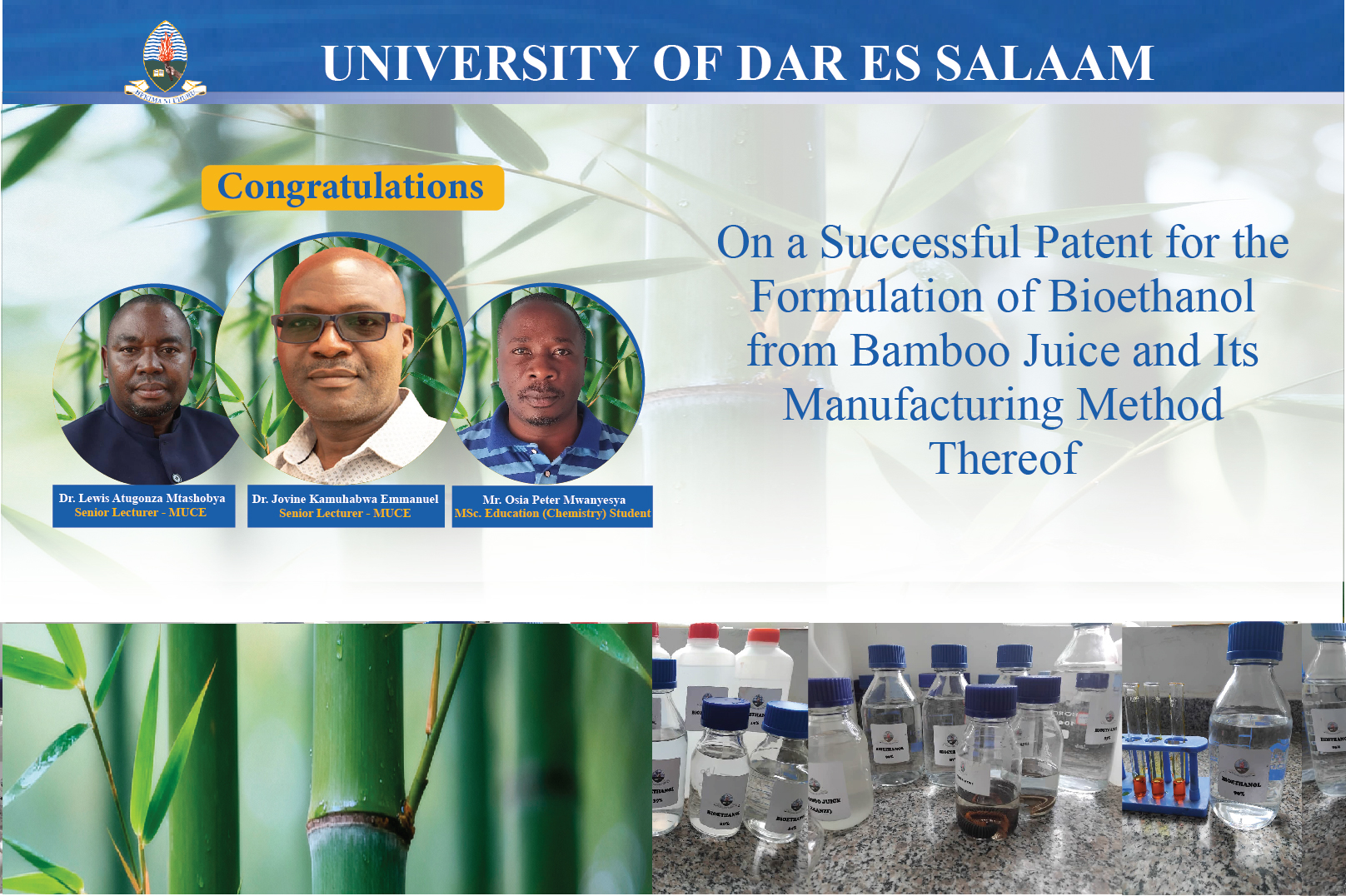
UDSM Breaks New Ground: Bamboo-Based Bioethanol Patent Paves Way for Sustainable Energy and Bio-Based Products Innovation
By Jackson Isdory, CMU
The University of Dar es Salaam (UDSM) has once again reinforced its reputation as a leading hub for research and innovation with the grant of a national patent, from the Business Registrations and Licensing Agency (BRELA), of Bamboo-based Bioethanol.
The patent recognizes an inventive technology titled Formulation of Bioethanol from Bamboo Juice and Its Manufacturing Method Thereof, developed through research at Mkwawa University College of Education (MUCE), a Constituent College of UDSM.
The patent, whose Application No. is TZ/P/2026/000014, represents a landmark achievement for UDSM’s innovation ecosystem, highlighting the University’s commitment to transforming scientific research into practical solutions that address national development priorities and sustainable industrial growth.
The patented technology showcases how bioethanol is produced from bamboo juice using natural additives, to enhance hydrolysis and fermentation efficiency. This eco-friendly process eliminates the need for corrosive chemicals and expensive commercial enzymes traditionally required in bioethanol production.
Beyond its scientific novelty, the innovation transforms an underutilized agricultural resource into valuable green energy products while reducing post-harvest losses in bamboo-growing regions.
The research team comprises Dr. Jovine Kamuhabawa Emmanuel and Dr. Lewis Atugonza Mtashobya, senior lecturers in MUCE’s Department of Chemistry, along with MSc. Education (Chemistry) student Mr. Osia Peter Mwanyesya.
Dr. Emmanuel explained, "Traditional bioethanol methods rely heavily on chemicals and costly enzymes. Our approach uses natural additives to enhance hydrolysis and fermentation, making the process safer, more affordable, and environmentally sustainable."
Dr. Mtashobya highlighted its broader impact: "This innovation supports renewable energy, value added product (clinical spirit, laboratory preservative and solvent), and other bio-based products development, circular bio-economy initiatives, and new economic opportunities for bamboo-farming communities."
Mr. Mwanyesya emphasized the importance of local resource integration: "Our work shows that locally available bamboo juice can be converted into sustainable bioenergy and other bio-based products of higher value, reducing agricultural waste while creating valuable products."
A reflection of the College’s growing research capabilities
Leadership at MUCE hailed the patent as a reflection of the College’s growing research capabilities. Prof. Method Samwel Semiono, Principal of MUCE, described the patent as a milestone for both the College and UDSM.
"BRELA’s recognition highlights the transformative role universities play in advancing science, technology, and innovation. MUCE continues to develop solutions that support Tanzania’s development agenda and the global shift toward sustainable bioproducts”, said Prof. Semiono.
Prof. Deusdedit A. Rwehumbiza, Deputy Principal for Academic, Research and Consultancy, said the patent showcases the vibrant research culture at MUCE.
“It demonstrates how collaboration between experienced researchers and postgraduate students can yield innovations that advance energy security, environmental sustainability, industrial development and socioeconomic principles that drive local economic development in Tanzania”, he said.
Dr. Selina Mkimbili, Director of Research at MUCE, added, "This achievement underscores our commitment to nurturing innovations that integrate postgraduate research with practical scientific applications capable of contributing to sustainable energy development."
Advancing Research, Intellectual Property, and Commercialization
UDSM’s Manager of Intellectual Property, Dr. Judith Jacob Iddy, said the patent further strengthens UDSM’s intellectual property portfolio and underscores the University’s commitment to commercialization.
"Securing intellectual property rights ensures our researchers’ innovations can be translated into marketable technologies, benefiting industry, society, and the national economy. It also opens doors for partnerships and technology transfer opportunities’, she said.
Disclosed during UDSM’s Research and Innovation Week, the technology has already generated interest for its renewable energy applications, bio-based products, and potential to support green industrial processes, rural livelihoods, and job creation.
By converting bamboo juice, an often-underutilized resource, into bioethanol, UDSM demonstrates how university-led research can deliver tangible solutions that advance sustainable economic growth. This latest patent reinforces UDSM’s position as a regional leader in research and innovation, illustrating the transformative power of science in addressing real-world challenges.