






UDSM Strengthens ESG Reporting Capacity Through Strategic, Forward-Looking Training
By Donald Boneka, CMU
The University of Dar es Salaam (UDSM) has reinforced its commitment to sustainability and institutional accountability through a comprehensive training on Environmental, Social and Governance (ESG) reporting – marking a significant step toward building a robust, coordinated, and globally aligned reporting system.
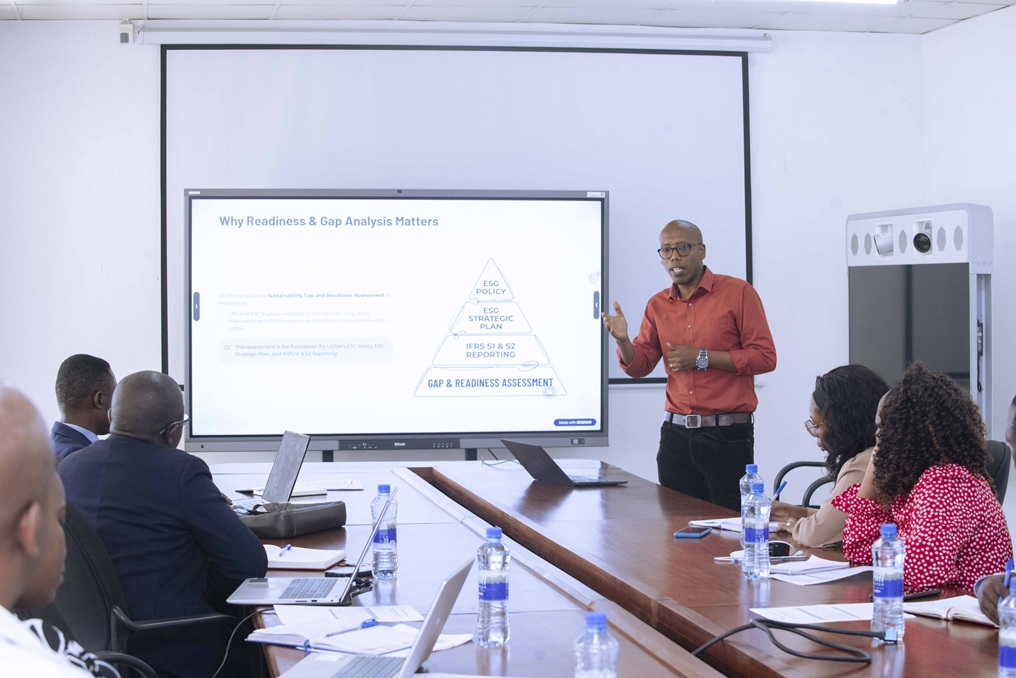
Held on 9 April 2026 at the University’s main campus, the training brought together ESG Data Owners from across various units in a collective effort to enhance data management, governance, and reporting practices.
The initiative reflects a growing recognition that universities must not only generate knowledge but also demonstrate leadership in sustainability, transparency, and responsible governance.
Opening the session, the Acting Director of Planning, Development and Investment at UDSM, Dr. Omari Zuberi, underscored the strategic importance of ESG in today’s institutional landscape.
“ESG is no longer optional; it is a defining measure of how institutions are assessed, governed, and trusted”, he said.
He emphasized that UDSM must move beyond compliance to leadership:
“We must position ourselves not just to meet regulatory requirements, but to lead in embedding sustainability into our systems and operations.”
Highlighting the central role of data, he added: “Institutional credibility in the ESG era will depend on our ability to produce accurate, consistent, and decision-useful information.”
The training was facilitated by experts from the University of Dar es Salaam Business School (UDBS), led by Dr. Emmanuel Christopher, alongside Dr. Ally Adam Mshana.
Through a structured and practical approach, the facilitators guided participants from conceptual understanding to real-world application, ensuring ESG principles could be directly integrated into daily university operations.
Participants explored how ESG is already embedded in institutional activities. Environmental aspects were linked to energy use, water consumption, transport, and waste management; social dimensions to staff welfare, student support, and inclusion; and governance to leadership systems, accountability structures, and ethical conduct.
The key message was clear; ESG is not about introducing new work, but about systematically capturing and reporting what already exists.
Alignment with global reporting frameworks
A central component of the training was alignment with global reporting frameworks, particularly IFRS S1 and S2, which require disclosures on governance, strategy, risk management, and measurable targets.
Unlike traditional reporting, ESG demands a forward-looking approach, placing greater emphasis on risks, opportunities, and long-term sustainability performance.
A candid assessment of UDSM’s readiness revealed strong governance and social systems, but highlighted gaps in environmental data management, particularly in areas such as energy, water, waste, and emissions. These gaps, participants were told, present an opportunity to strengthen systems, improve coordination, and enhance overall ESG performance.
One of the most transformative takeaways was the repositioning of Data Owners at the center of ESG implementation.
“ESG reporting starts with you,” facilitators emphasized, reinforcing that credible reporting depends on accurate, timely, and verifiable data generated at the operational level.
Participants were encouraged to see themselves not as passive contributors, but as key drivers of institutional compliance and performance.
The training also provided practical tools, including standardized data templates, key performance indicators, and clear data flow mechanisms, from collection and validation to consolidation and reporting. Emphasis was placed on data quality, with strict requirements for consistency, traceability, and evidence-based reporting.
In this session, participants developed both technical capacity and a shared sense of purpose, recognizing ESG as a strategic pillar of institutional excellence rather than a routine reporting obligation.
This training marks a critical milestone in UDSM’s journey toward sustainability, transparency, and global relevance. With strengthened capacity, clear systems, and empowered data owners, the University is well positioned to deliver credible ESG reports and set a benchmark for higher education institutions in Tanzania and the region.